Most companies talk about AI benefits. Fewer can show clear operational impact.
AIG (American International Group) recently shared that its use of generative and agentic AI is improving submission processing speed and helping teams handle more work without adding the same level of new headcount. For business leaders, this matters because faster underwriting and claims workflows usually mean better customer response times and stronger margins.
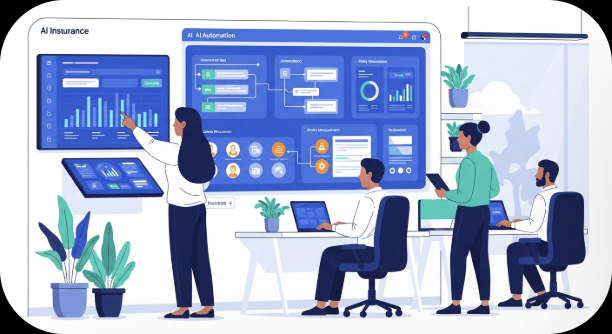
In simple terms, AIG is not only using a chatbot. It is building a system where multiple AI helpers work together through an orchestration layer.
What AIG Is Doing Differently
AIG says it uses AI to extract and summarize incoming submission data, then route it through underwriting and claims workflows more efficiently. The company also described an orchestration layer that coordinates multiple AI agents.
This is important. One AI model can answer questions. But coordinated AI agents can support a real business process from start to finish.
AIG also linked its AI work to practical outcomes:
- Faster submission handling n- Better throughput in core insurance workflows
- More support for underwriting decisions with historical context
- Reduced time spent on repetitive manual tasks
For any service business, this pattern is familiar: high-volume documents come in, teams review and decide, and delays create cost.
Why This Matters for Buyers of AI Services
If you are evaluating AI automation for your company, the AIG example gives a useful framework:
-
Start from a bottleneck, not from hype. Pick one process where speed and quality both matter (for example intake, qualification, quoting, support triage, or claims review).
-
Use AI for structured assistance first. Begin with extraction, summarization, and recommendation. Keep final decision control with your team while confidence builds.
-
Add orchestration to connect steps. Real value comes when AI actions are connected across tools and teams, not trapped inside one chat window.
-
Track measurable business outcomes. Monitor cycle time, throughput, manual effort, and error rates. These metrics make ROI clear to leadership.
A Practical Rollout Plan (90 Days)
Here is a practical plan for organizations that want similar results:
Phase 1 (Weeks 1-3): Discovery and Design
- Map one target workflow end to end
- Identify repetitive steps, handoffs, and delays
- Define success metrics (for example: 30% faster processing time)
Phase 2 (Weeks 4-8): Pilot Build
- Set up AI extraction and summarization for incoming documents
- Add business rules and human review checkpoints
- Integrate with your existing CRM, ticketing, or policy systems
Phase 3 (Weeks 9-12): Orchestration and Scale
- Connect multiple AI tasks into one managed flow
- Add monitoring dashboards for quality and speed
- Expand to adjacent workflows after pilot success
Common Mistakes to Avoid
Many projects fail because teams expect instant full automation. A more reliable path is staged implementation.
Avoid these mistakes:
- Trying to automate every process at once
- Ignoring data quality in source systems
- Not defining clear ownership between AI and human reviewers
- Measuring outputs but not business outcomes
What “Good” Looks Like
A successful AI automation program should feel practical, not flashy.
You should see:
- Teams spending less time on repetitive admin work
- Faster customer response and turnaround times
- Better decision support for complex cases
- A clear dashboard that shows performance improvements
This is exactly why orchestration matters: it turns separate AI features into a reliable operating model.
Final Takeaway
AIG’s update is a strong reminder that AI value is no longer theoretical. The biggest wins come from workflow-level automation, where AI agents support people and systems together.
For growing businesses, the message is simple: start with one high-impact process, design for measurable outcomes, and scale with orchestration.
That is how AI moves from experimentation to real operational advantage.