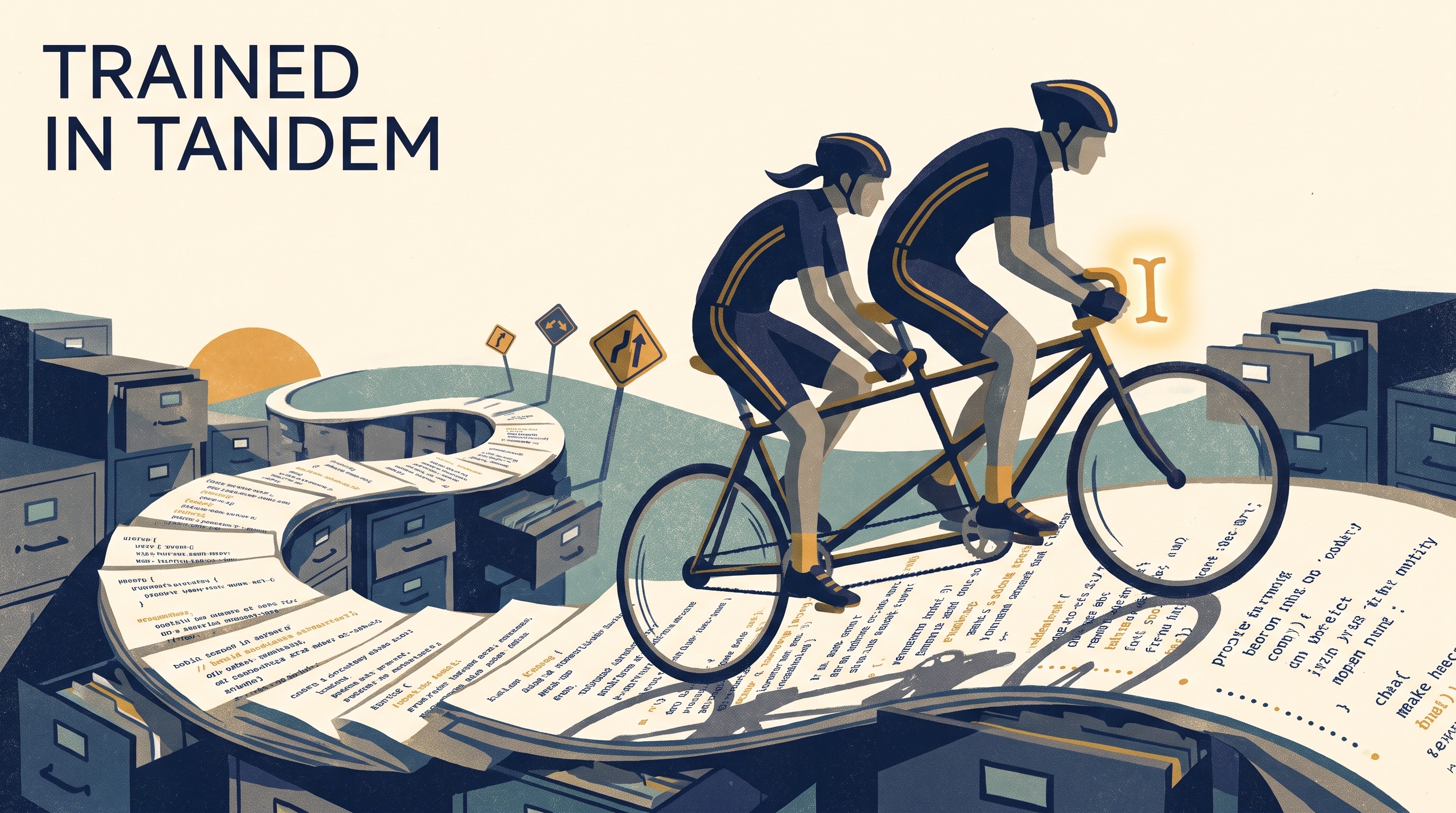
xAI just dropped Grok 4.5, and if you build software for a living, there's a detail in the announcement you shouldn't scroll past. This model was trained alongside Cursor.
That matters more than the benchmark numbers. Cursor is the AI coding IDE that's taken over a serious chunk of engineering workflows. xAI didn't just build another frontier model and sprinkle it with coding claims. They tightly coupled Grok 4.5's training to the actual environment developers live in every day. That's a different kind of signal.
xAI released Grok 4.5 as their strongest model to date, positioning it squarely at coding, agentic tasks, and knowledge work. The scale of the training infrastructure is genuinely impressive: the model was trained across tens of thousands of NVIDIA GB300 GPUs, with heavy investment in data curation, including deduplication and quality scoring passes. These aren't marketing lines. They're the kind of infrastructure decisions that translate directly into model behaviour on hard technical problems.
The benchmarks put Grok 4.5 near the top of the frontier for coding, science, engineering, and mathematics. xAI's framing is unambiguous: they're going directly at the models technical teams reach for when they want something that actually writes good code, not just plausible-looking code.
The Cursor angle is worth sitting with. When a model's training is shaped by feedback inside a real coding environment, it's not just learning to produce text that resembles code. It's learning patterns that come from millions of developers actually accepting, rejecting, and iterating on suggestions in context. That kind of signal is hard to replicate from static datasets alone.
The Bigger Shift
Most capable models right now are broadly good at everything, and teams tend to pick one based on habit rather than because it meaningfully outperforms on their actual workload. Grok 4.5 is a bet that specialisation towards coding and agentic work is the better strategy.
The agentic angle is arguably more important than the coding benchmarks. Most teams are moving from "AI helps me write this function" to "AI agents handle this whole workflow." A model explicitly optimised for multi-step, tool-using, context-holding agentic tasks means you're not adapting a general-purpose model to agent work. You're starting from something built with that use case in mind.
For product teams and founders, this also changes the calculus on what's feasible. Agentic systems that felt unreliable six months ago, because the underlying model would lose the plot halfway through a long reasoning chain, start to look viable again when the model has been specifically trained for it.
What This Means If You're Building
At Dakik, we build exactly the kinds of systems that benefit most from a model like Grok 4.5. Whether that's a RAG pipeline that lets your engineering team query their own documentation, a custom agent that handles a multi-step workflow end to end, or a code-generation feature baked directly into your product, we do the plumbing that turns a capable model into something that ships and works at scale.
We've written before about how xAI's releases have consistently pushed towards task-specific design, including their approach to voice. Grok 4.5 is the same philosophy applied to the harder problem of reasoning, coding, and agentic execution.
The teams that benefit from releases like this aren't the ones that read the announcement and add it to the backlog. They're the ones that get it into a testbed this week, run it against their current model on their actual workload, and make a call based on real results. That's the kind of evaluation work we help clients do.
If you've been sitting on an AI feature because you weren't confident the models were reliable enough, Grok 4.5 is another reason to revisit that decision. The gap between "interesting demo" and "ships in production" is mostly integration work now. That's exactly where we focus.