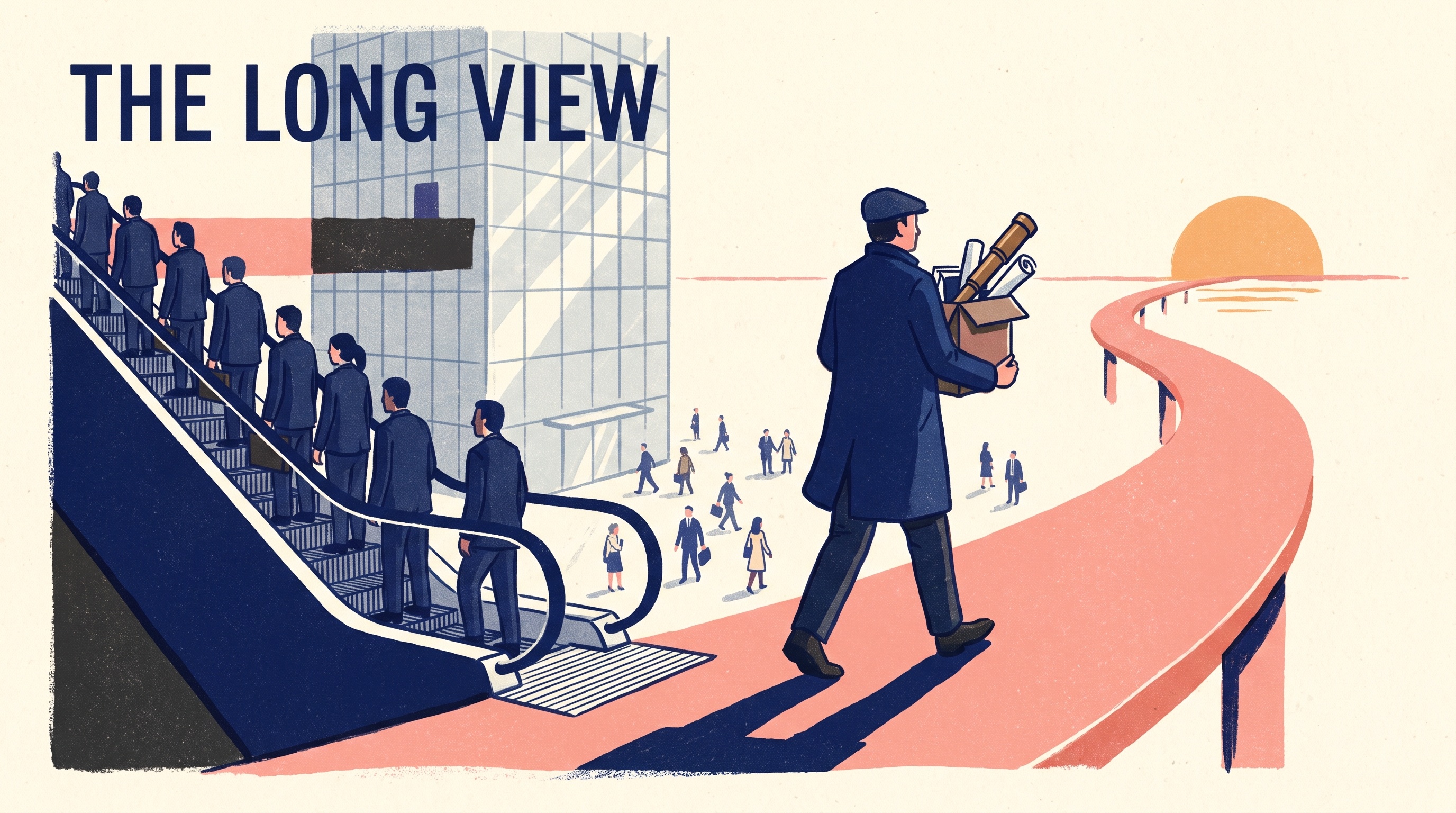
Joshua Achiam joined OpenAI in 2017 as a 25-year-old intern. He left this month as chief futurist, at a company that now shapes the direction of the entire industry. He's stepping away not because things went wrong, but because he thinks he can do the work that matters most from somewhere else entirely.
That's the bit worth sitting with.
Achiam's departure isn't a scandal or a blowup. He said so directly: "There's not a specific reason for me leaving, or a specific reason for why now. But it's something I have been thinking of for a while and it feels right." His plan is to keep working toward safe AGI, just outside the walls of a frontier lab.
When he started, computers couldn't talk or think in any meaningful sense. By the time he walked out the door, they were solving frontier science problems. He watched the whole arc from the inside. And now he's saying: you don't have to be inside to shape what comes next.
What This Actually Signals
The departure itself is news. A chief futurist at one of the most consequential companies in the world stepping back voluntarily, mid-acceleration, is at least interesting. But the more substantive point is the philosophy behind it.
For years, the prevailing assumption has been that serious AI safety work happens at the frontier labs. The reasoning made sense: if the biggest risks come from the most powerful systems, and only a handful of organisations can build those systems, then meaningful safety work has to live inside those organisations. Outsiders are commentators at best.
Achiam's move chips away at that framing. He's betting that working on safe AGI from outside a frontier lab is genuinely possible, not just a consolation prize. That's a signal that the safety conversation is spreading outwards, into smaller organisations, into product teams, and into the builders who are actually putting AI in front of millions of people.
That spreading matters. Because the safety decisions that affect most users aren't made inside OpenAI or Anthropic. They're made in product roadmaps, in agent architectures, in the prompts and guardrails that teams ship every sprint.
What It Means If You're Building With AI
Here's the practical read for product teams and founders: AI safety isn't a labs-only problem anymore, if it ever was. Every team integrating LLMs, building agents, or shipping AI-powered features is making safety decisions whether they call them that or not. How you constrain an agent's actions. What data you send to external models. How you design the fallbacks when a model goes off the rails.
These are product decisions with real consequences for your users and your company. And the expertise to make them well is no longer locked inside the frontier labs.
Dakik builds production AI systems for founders and product teams, and safety considerations run through all of it. Not as a compliance checkbox, but as good engineering. When we're building a RAG pipeline, the question of what the model can and can't access is architectural, not an afterthought. When we design agent systems, how tightly we constrain the action space is a first-class product decision. When we integrate LLMs into user-facing features, adversarial inputs and edge cases go into the build spec, not the hotfix list.
If you're a product team that's been treating AI safety as somebody else's job, the news here is that the people closest to the problem are saying otherwise. And if you want a team that builds AI with appropriate guardrails from day one rather than bolting them on later, that's exactly the kind of work we do.
Achiam's bet now is that the next stage of AI's development doesn't require a frontier lab badge. For the teams building AI products today, that's not just an interesting exit interview. It's a prompt to take ownership of the safety questions in your own stack.