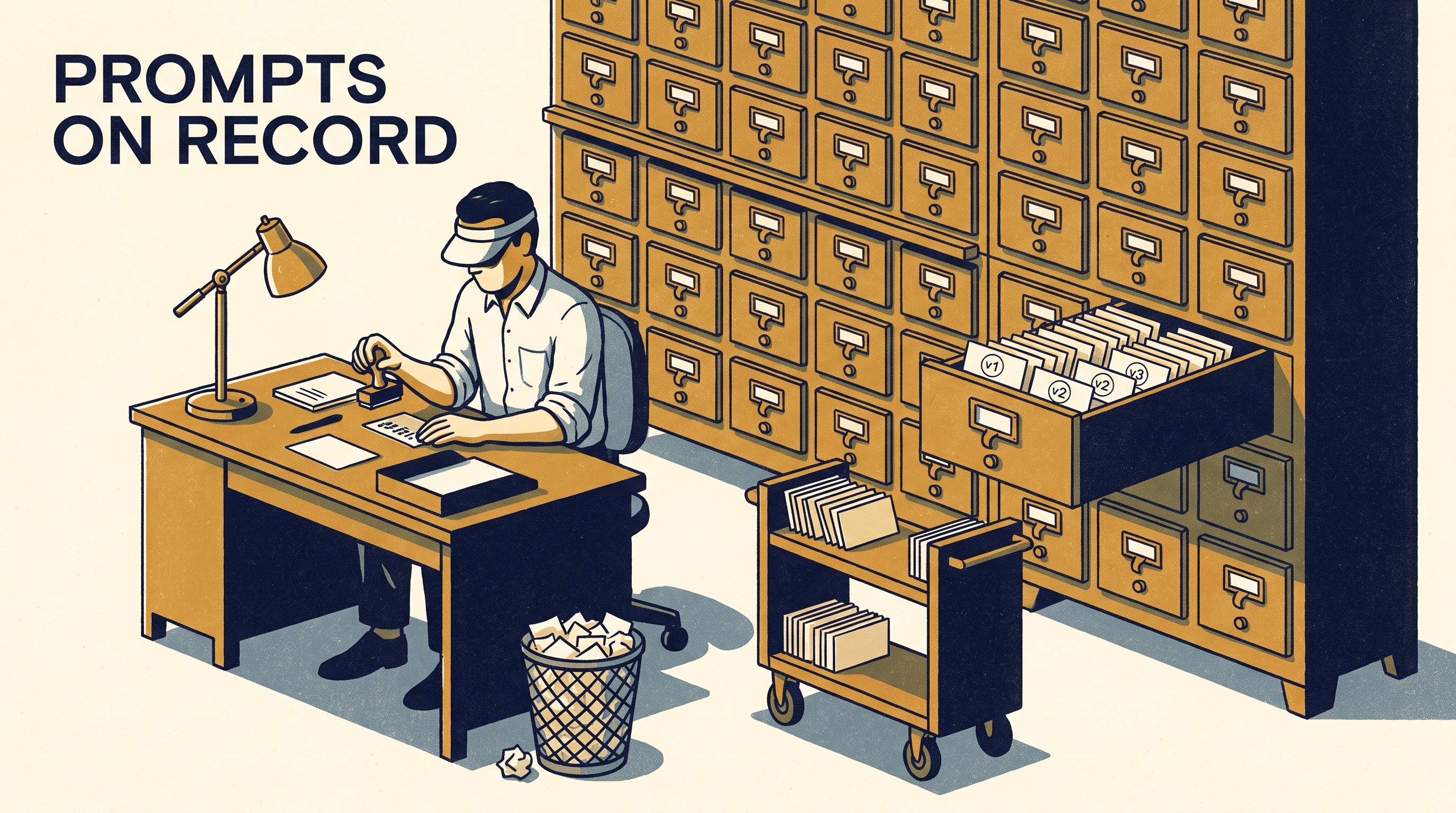
It's an uncomfortable question: if someone asked you right now what exact prompt is powering your AI feature in production, could you answer? Most teams can't. Mistral knows this, and they've done something about it.
Last week, Mistral launched a system of record for AI prompts and skills inside Studio. The headline is versioning, but that undersells what's actually been built. This is closer to what you'd expect from a mature software platform: immutable version histories, ownership assignment, audit logs, classification labels (think "Production" vs "Staging"), and one-click rollback. Every time someone touches a prompt, it's tracked. Every time something breaks, you can trace it back.
One quote from the announcement cuts right to the problem: "Most enterprises can't say which version of a prompt is running in their AI right now."
That's not a niche edge case. That's most teams building on AI today.
Why prompt drift is a real problem
The dirty secret of shipping AI features is that prompts drift. A developer tweaks a prompt in a notebook to fix a live bug. A product manager pastes an improved version into Slack. Someone copies it into the repo but loses a line. Six months later you have three versions of "the prompt" living in four different places, and nobody's sure which one is actually in production. When something goes wrong, you're debugging blind.
What Mistral has shipped treats prompts as production assets with proper governance, not sticky notes passed around in chat. Non-technical team members, domain experts and line-of-business people, can now iterate on prompts directly without needing a full CI/CD deployment cycle. When it's time to push to production, the existing approval gates still apply. Fast iteration where it's safe, proper control where it matters.
The MCP angle is worth flagging too. Skills in Mistral Studio are now accessible as MCP servers directly from the platform. If you're building agents that need to call specific capabilities, you can manage, version, and audit those skills the same way you manage prompts. That's a meaningful step towards treating AI components like the production software they are.
How Dakik can help
We build RAG pipelines and custom agents for clients, and the prompt management problem shows up on nearly every engagement. The usual pattern: prompts live scattered across the codebase, evolve through git commits, and there's no easy way for non-developers to refine them without a full deployment cycle. That's a bottleneck, and it creates real risk.
If you're running AI features in production and want a cleaner setup, there are a few concrete things we can do. We can integrate Mistral Studio into your existing workflow so every prompt and skill has a proper home with a full audit trail. We can wire up the observability layer so you can trace outputs back to specific prompt versions when things go wrong. And if you're earlier in the process and want to work out what your AI governance setup should actually look like, that's a conversation we're well-placed to have.
The era of sorting prompt management out later is over. Mistral just made it straightforward to get this right from the start.