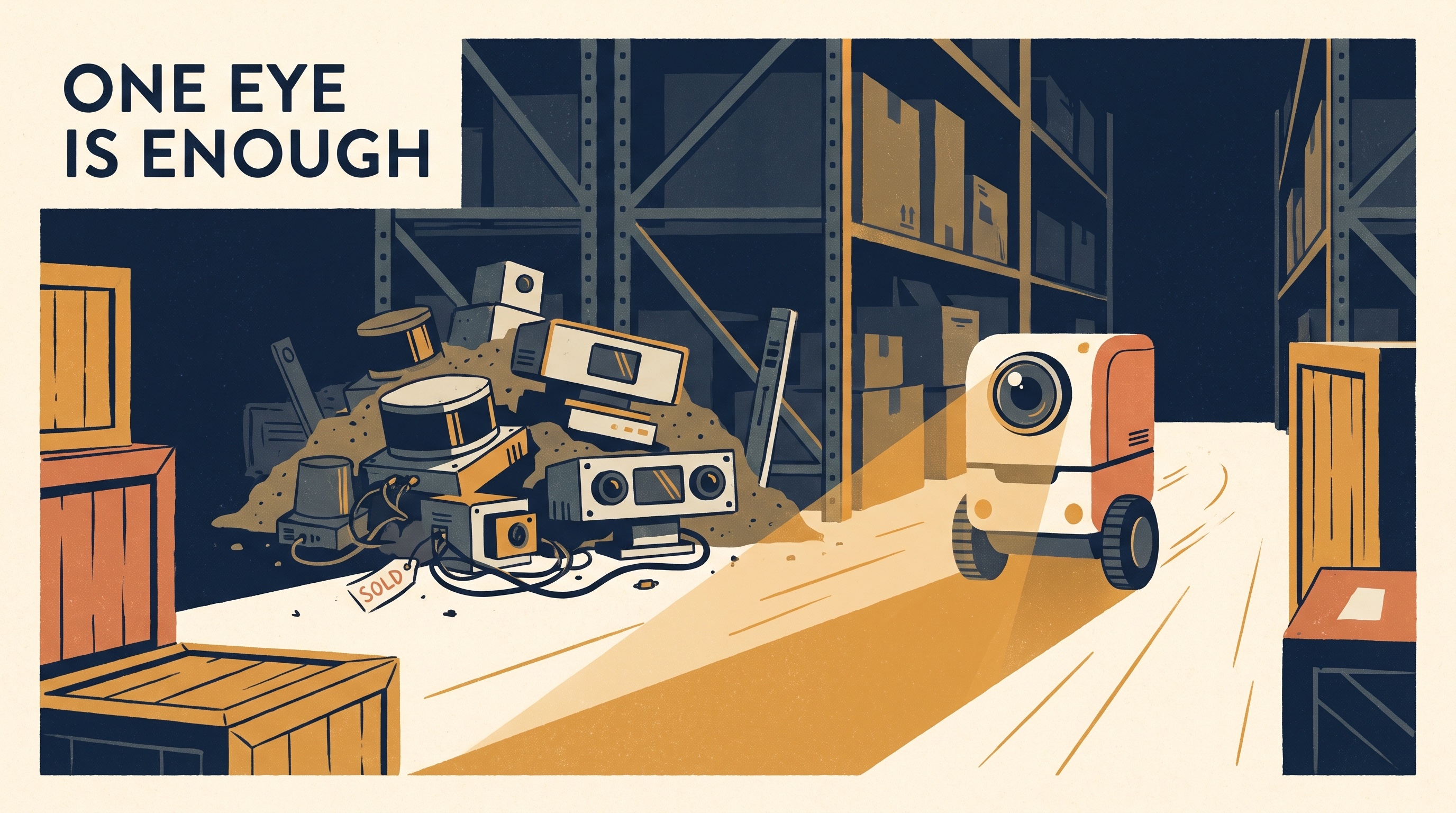
Robots have historically been expensive and annoying to deploy. You'd typically need a depth sensor here, a stereo rig there, maybe a lidar for good measure, then a software stack to fuse all of it before anything actually moved in a useful direction. Navigation was one of the nastiest problems to solve, and the hardware bill to do it reliably was serious.
Mistral has just changed the calculation. Robostral Navigate is an 8-billion parameter model that gives a robot the ability to navigate using a single standard RGB camera. The kind you'd find in a phone. On unseen R2R-CE benchmarks, it achieves 76.6% success, and it outperforms approaches that rely on depth sensors or multiple cameras. That's not a marginal improvement. That's a fundamentally different approach to the problem.
What the model actually does
Robostral uses pointing-based navigation combined with reinforcement learning. Give it a task and a history of what the robot has seen, and it predicts where to move next by pointing to the target in the image. When the target is outside the camera's field of view, it switches to displacement commands in the robot's local coordinate frame. Simple in concept. Genuinely difficult to get right.
Training involved roughly 400,000 trajectories across 6,000 simulated scenes. The interesting part is the efficiency: Mistral used prefix-caching techniques that reduced the number of training tokens by 22 times while preserving all the learning signals. A training run that would previously have taken months came down to days. That's not just a headline number. That's what turns a research idea into something a commercial team can actually iterate on quickly.
The model was built entirely in-house, without any existing open-source vision-language models as a foundation. Once trained, it generalises across wheeled robots, legged robots, and flying drones, and it holds up when you swap to different camera hardware. Post-training reinforcement learning added another 3.2% to the success rate, and the Mistral team says they haven't seen a performance plateau yet.
Why this matters for product teams
The headline is cost and simplicity. A single RGB camera is cheap, small, and everywhere. If you can navigate reliably with one, you've eliminated a serious chunk of the engineering complexity that makes robotics projects expensive to start and fragile to maintain. That matters at the hardware level, and it matters at the integration level too.
This is also part of a broader pattern showing up across AI right now: doing more with less, at the edge, without a cloud dependency. A small model, trained efficiently, running on minimal sensors, delivering useful capability in a physical environment. The implications stretch well beyond robots. If you're thinking about autonomous systems in healthcare, logistics, retail, or any space where things need to move through a physical environment without constant human input, the economics here are genuinely worth paying attention to.
The gap between compelling research and something you can actually build on top of is narrowing. Robostral looks like it's already on the right side of that line.
What Dakik can help you build
We build AI systems that ship. That's the short version. Our work covers RAG pipelines, custom agents, and vector search with Qdrant, alongside React, Next.js, Flutter, and .NET delivery. Which means if you need the model integration and the app layer done in one place by one team, we do that.
If you're a founder or product team with robotics, edge AI, or autonomous systems anywhere on the roadmap, we can help you work out what integration looks like in practice. What sensor setup do you actually need? Where does the model live? What does the interface look like on the other side? These are the kinds of questions we work through with clients every week.
The efficient training approach Mistral used here is also worth noting separately. The prefix-caching technique that cut training tokens by 22 times has applications beyond navigation. If you're building custom AI systems where training or fine-tuning is a bottleneck, there are real lessons in this work that transfer.
If Robostral or anything in this space connects to something you're trying to build, get in touch. We're in London, we move quickly, and we'd rather show you a prototype than write you a roadmap document.