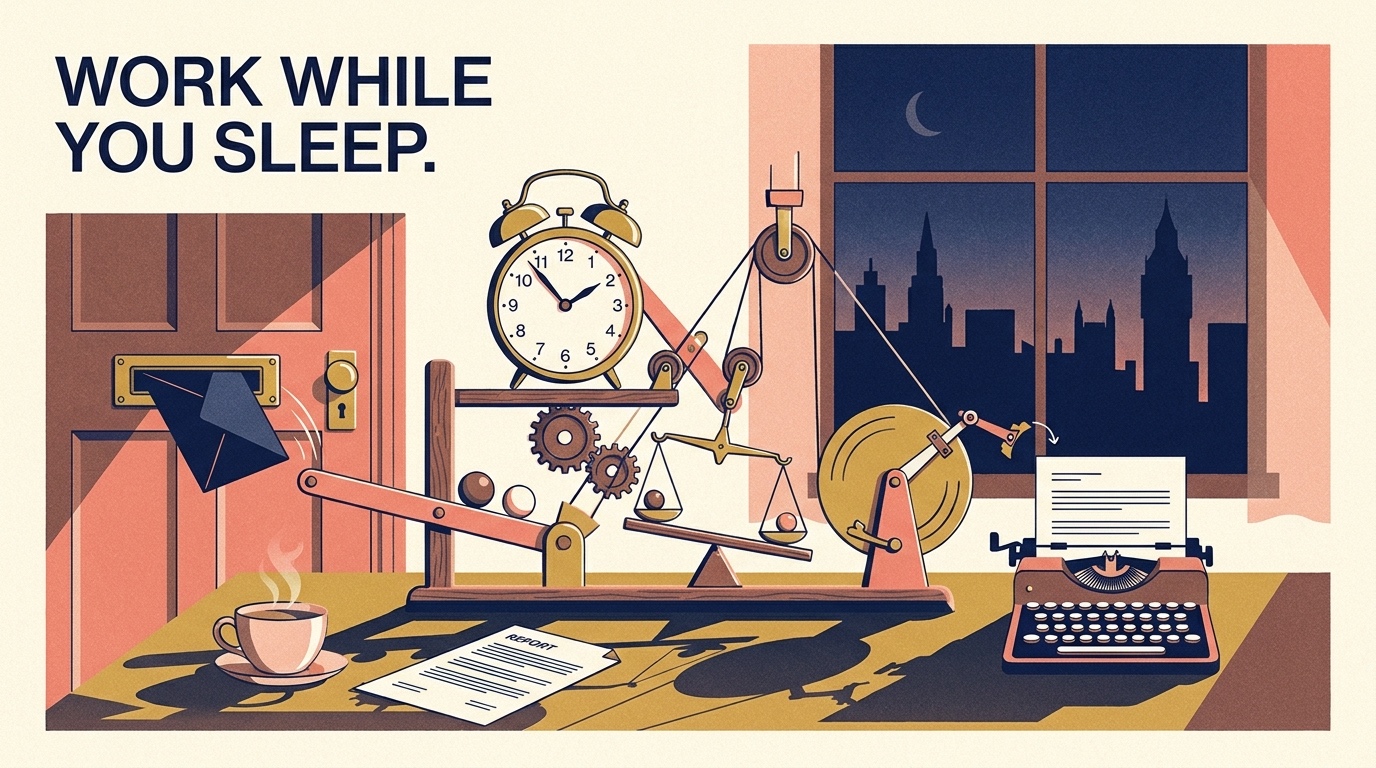
Chatbots have an embarrassing limitation that nobody in the demo videos likes to dwell on: they only work while you're sitting there typing at them. Close the tab and all that intelligence goes idle, waiting for you to come back and prompt it. This week xAI shipped its answer to that. It's called Automations, it turns Grok into something closer to a background worker than a chat window, and the design decisions inside the announcement are worth a proper look if you're building anything agent-shaped.
What xAI actually shipped
The pitch, in xAI's own words: "jobs Grok runs on its own. Describe the work once, choose when it runs, and Grok takes it from there." The examples they lead with are research done before you wake up and an important email flagged the moment it lands. Automations are live on grok.com and in the Grok apps on iOS and Android.
The mechanics are simple to describe and quietly clever underneath. An automation's instructions read like any chat message. You describe what you want, attach files for context, add connectors and skills, pick a mode, then name it and save it. From that point, and this is the line in the announcement that matters most, "every run is a fresh request: same instructions, current data."
There are two ways a run gets kicked off. Schedules are the familiar one: once, daily, weekdays, weekly, monthly or yearly, at a time you choose in your own timezone. A morning brief at 8:00, a rent reminder on the 1st. The second is more interesting. Email triggers watch your inbox, and when an incoming message matches your filters (sender, recipient or subject), the automation fires with that email as context. Grok doesn't just get told "an email arrived", it responds to the actual message. Instructions can also point at your tools directly: type @ to mention a connector, and Grok uses it on every run. There's a Run now button for testing an automation straight after you've built it, which tells you xAI has actually watched people build these things.
Then there's the output side. When an automation fires, Grok opens a real conversation, does the work, and saves the result to its run history. You can open any run and read the full thread, or pick up the conversation where Grok left off. You choose how each automation reports back: email, app notification, both, or neither if you'd rather check in yourself. You can also create automations straight from chat by just asking for one ("check the news every morning and flag anything about pricing"), and there are suggested templates. Anything can be paused, resumed, edited or deleted. Scheduled automations are available to everyone; email triggers are behind the SuperGrok subscription.
The three design decisions worth stealing
Strip away the branding and there are three choices here that anyone designing an agent workflow should sketch on a whiteboard.
First, statelessness. "Every run is a fresh request: same instructions, current data" is cron semantics applied to an LLM. Each run starts from the same fixed prompt and pulls whatever the world looks like right now. There's no long-lived agent accumulating context, drifting off-brief, or hauling around three weeks of stale conversation. That makes runs predictable, debuggable and cheap to reason about, and it's exactly how you'd want to build this even if xAI hadn't. The failure mode of persistent agents is that run forty behaves nothing like run one. Fresh-request-per-run kills that class of bug at the root.
Second, runs as conversations rather than logs. Every execution lands in a run history as a full thread you can read and, crucially, continue. That's an audit trail and an escape hatch in one. When the output is wrong, you don't file a bug against a black box, you open the thread, see the reasoning, and type "no, exclude the weekend figures" right where it went sideways. Most automation platforms give you a log line and an exit code. Giving you a resumable conversation is a genuinely better contract between a human and a flaky worker.
Third, email as an event bus. Schedules are table stakes; time-based triggers have existed since the 1970s. Wiring an agent to inbound email is the bit with teeth, because email is still the default event stream of business. Invoices, complaints, sign-ups, supplier updates: it all arrives as email long before it arrives as a webhook. Letting a filter on sender, recipient or subject fire an LLM run, with the message itself as context, turns the inbox into a queue and Grok into the consumer. Notice, too, that email triggers are the paid tier. That's xAI telling you, in pricing, that event-driven runs are where the real compute and the real value sit.
We've written before about xAI's habit of shipping infrastructure with opinions baked in, most recently when they open-sourced Grok Build. This is the same instinct pointed at scheduling.
What this doesn't tell you
Let's be honest about what this announcement is: a product launch post, not research. There are no benchmarks, no reliability numbers, no data on how often runs fail or hallucinate, and no detail on error handling, retries, cost controls, or what happens when an automation misreads an email and does something confidently wrong at 3am. The trigger filters are also narrow: sender, recipient and subject only, at least as described. Anyone who's run scheduled LLM jobs in production knows the hard part isn't the cron expression, it's the morning you discover the job has been producing polished nonsense for a week because an upstream source changed shape. Nothing in this announcement tells you how Grok handles that, and until someone runs these in anger, treat the reliability question as open.
The other caveat is scope. This lives inside Grok's own apps, against your personal inbox and xAI's connectors. Useful for individuals, but if you're a product team, your users' workflows live in your product, not in someone else's chat app.
The pattern travels even if you never touch Grok
Here's the thing that actually matters for anyone deciding where to spend engineering budget: this shape is not proprietary. Describe a job once in plain language, fire it on a schedule or an inbound event, run it stateless against current data, log every run as an inspectable thread, let a human pick up the thread when it matters. That's an architecture, not a feature of Grok, and every piece of it is buildable today on whatever stack you already run.
This is squarely the kind of work we do at Dakik. We're a London studio that builds AI features into real products: agent workflows, LLM integrations, the unglamorous plumbing that makes them trustworthy. A sensible first commission here is small. Pick one recurring job your team does by hand, a morning digest over your own data, triage of a shared inbox, a weekly report nobody enjoys writing, and we'll build it as a proof of concept in your own system: your data sources, your triggers, a run history your team can actually audit, and a human-in-the-loop step wherever it touches customers. A few weeks of work, and you'll know precisely how much of your ops load this pattern can carry before you bet anything bigger on it.
xAI just showed everyone what the ambient agent looks like as a consumer product. The teams that win the next twelve months won't be the ones watching Grok do their personal errands. They'll be the ones who noticed the blueprint was published and quietly built it into their own product while everyone else was still typing into chat windows.